
The Long Memory of “I AM”
Updated: May 4
This essay traces the long journey of the phrase “I AM” from pre-history to present.
Before the poet could write, or even sign their name this structure was spoken as ritual, an utterance used to establish identity, to invoke authority, and survive what lay beyond the threshold of death.
Over time. It has been inherited, reshaped, and repurposed by successive world orders. Its form remains recognizable even as allegiances shift.
To follow the “I AM” is to follow the rise of a voice that can command belief without the speaker present.
Once writing detaches words from the living voice, authority must be rebuilt on the page. The “I AM” becomes that mechanism. It is never discarded only adapted, translated, and fitted into the prevailing language of power.
The enduring exhortation of “I AM.”
The “I AM” begins as ritual speech, becomes personal voice, is seized by theology as absolute authorship, is destabilized by mysticism, redistributed by revolutionary poetics, operationalized in political resistance, and internalized as psychological integration.
Across this arc, we find that linguistic structures do not erase earlier forms, they absorb and reframe them, using the familiarity of the structure to secure recognition, and continuity.
In the Beginning

The “I AM” first appeared as paperwork for eternity.
In the funerary chambers of the the Pyramid Texts (c. 2400 BCE), the Pharaoh does not describe himself, he declares himself. “I am…” is a spell of passage, a credential presented to the afterlife bureaucracy.
These are not poetic flourishes but acts of power. The “I AM” operates as an identity protocol. The Pharaoh isn’t describing himself, he’s credentialing himself in divine terms.
The Pyramid Texts are ritual utterances meant to transform the deceased into a divine being and guide his ascent into the afterlife.
This transformation is more procedural than symbolic.
One does not hope to become divine; one states it, firmly, like a border crossing official who cannot be bothered twice.
The king does not plead, or hope, or even describe. He identifies precisely, and repeatedly as belonging to the divine order he seeks to enter.
Utterances from the Pyramid Texts make this explicit:
“I am Re, who came forth from Nun…” (Utterance 600)
“My arm is Atum, my hand is Atum…” (cf. Utterances 213–222, cannibal hymn and bodily identifications)
“My bones are the bones of the gods, my flesh is their flesh…” (parallels appear across multiple utterances)
Here, the body itself is redefined as composite and divine. Each part is aligned with a god, each function mapped to a cosmic counterpart. The speaker is not an individual seeking entry. They are establishing continuity with the godhead.
To speak “I am” in this context is to declare origin, not personality.
The logic is precise:
If one is of the gods, one belongs among them.
If one belongs, one may pass.
If one may pass, one survives.
The utterance becomes a form of protection. Not because it persuades, but because it establishes identity.
Later, these ideas expand into what we call the Book of the Dead:
It includes spells, passwords, and instructions
It prepares the soul for judgment (weighing of the heart)
It helps navigate the Duat (underworld landscape)
When Enheduanna came along she created the Exaltation of Inanna (c. 2300 BCE) transforming the first-person voice into something new: authored, situated, and named.
Yes, the Pharaohs of 100 years prior spoke in the first person: “I am…”
But the “I am” in those texts were:
Formulaic (fixed phrases reused across tombs)
Ritualized (meant to perform a function, not express a perspective)
Ventriloquized (spoken as the king, but composed by priestly tradition)
In other words, the Pharaoh is the subject of the speech, not the identifiable author of it.
Enheduanna breaks that pattern

She is named inside the text
She references her own lived experience (exile, displacement)
She is not performing a role, she is positioning herself within the narrative
In the Exaltation of Inanna, the “I” is not interchangeable. It is specific, and more importantly, it is situated:
I was cast out
I appeal to you
Restore me
That’s a historical voice. That’s the birth of authorship as we understand it. Not merely first-person grammar, but first-person ownership.
The first one we have a name to pin to.
The first known author.
Her hymn becomes a negotiation. Enheduanna does not merely list the powers of Inanna; she argues them, situating divine authority within her own lived crisis: exile, political upheaval, displacement. Praise becomes leverage. Devotion becomes rhetoric. What is striking is how enduring Enheduanna’s hymnal structure has proven to be.
Enheduanna’s compositions follow a recognizable pattern:
direct address to the deity
extended praise through accumulation of attributes
a turn toward personal crisis or petition
a request for restoration, justice, or intervention
This pattern became foundational to later religious traditions, particularly in liturgical music, we find the same repetition.
In the Hebrew Psalms:
“I cry aloud to the Lord…” (direct address)
followed by exaltation of divine power
followed by personal distress and appeal for deliverance (see Book of Psalms, e.g., Psalm 22, Psalm 51)
In early Christian hymnody and liturgy:
invocations such as “Kyrie eleison” (“Lord, have mercy”) combine address, repetition, and petition
praise and supplication are interwoven rather than separated (see Early Christian Hymns)
In later devotional music traditions:
call-and-response gospel structures
repetitive praise escalating into personal testimony and appeal
the blending of exaltation with lived experience
Across these forms, the same functional sequence persists: praise → alignment → petition.
The speaker does not simply adore the divine. They establish relationship, then act within it.
This is the same maneuver Enheduanna performs: she names power, aligns herself with it, and then asks something of it.
In this sense, the hymnal form is not static tradition. It is a durable technology of address. One that continues to shape how humans speak to power, and how they expect power to respond.
What She Was Actually Doing
(Politically, Not Poetically)
Placed within the machinery of her father Sargon of Akkad and his expansion, Her work reads less as devotion and more as political strategy.
She travels under her father’s banner.
She encounters regionally distinct goddess traditions.
She aligns them under her goddess Inanna.
While she unites minds, her father unites territory.
This is cultural engineering.
Her hymns don’t just praise Inanna. They reframe her as the central authority capable of absorbing all local variants. She creates interoperability between belief systems.
And that interoperability of belief is what allows empire to function without constant rebellion.
When Enheduanna says “I AM,” she is not simply identifying herself. She is establishing her authority:
To speak as a priestess (ritual authority)
To speak as a political agent (imperial continuity)
To speak as a named individual (authorial presence)
By installing his daughter as high priestess of Nanna in Ur, Sargon of Akkad created a bridge between the Akkadian center and the Sumerian religious world. Political control alone was not enough. Belief systems had to be aligned.
Enheduanna’s hymns, made powerful by her narrative use of the I AM participated directly in that alignment. In her work, Inanna is not a local deity but a figure capable of absorbing and surpassing others. This is not simple praise, it is consolidation. A theological unification that mirrors imperial expansion.
The timing of The Exaltation of Inanna (nin-me-šara) is critical.
Internal evidence suggests it was composed during or just after her expulsion from Ur amid political upheaval. She writes:
“I was cast out from the sanctuary…”
“He made me walk in the thornbush of the mountains…”
This exile is commonly linked to a rebellion led by Lugal-Ane, who displaced her from office.
Seen this way, the hymn becomes intervention.
Enheduanna invokes Inanna at the precise moment imperial authority is under threat, reasserting divine order through language.
Praise becomes leverage. Devotion becomes rhetoric.
Her eventual restoration likely under Naram-Sin, suggests this alignment of divine authority and political continuity was effective.
Her work can be read as part of a broader imperial strategy:
unify religious language
stabilize cultural identity
reinforce power through shared cosmology
Enheduanna does not command armies, she makes rule intelligible and therefore sustainable.
Standardization
Centuries later, the structure is formalized in the aretalogies of Isis (c. 150 BCE onward) inscriptions that present a perfected divine voice:
“I am Isis, mistress of every land…”
Here, the “I AM” becomes stable, repeatable, institutional. It travels well. It governs well. It is empire-ready assisted by practices like Interpretatio graeca and Interpretatio romana, which translate local gods into a larger, identifiable system across cultures and tongues.

“I AM THAT I AM,”
The old forms remain recognizable enough to be absorbed, and altered enough to be governed. The divine voice is fitted, carefully, into what looks suspiciously like a new pair of imperial shoes.
In the Book of Exodus, when God declares “I AM THAT I AM,” the structure flips again:
It’s no longer a human borrowing divine voice
It’s authority itself speaking in the first person
So the same structure becomes the ultimate monopoly on authorship.
And then, from within that structure as grasped and wielded by Rome…
The Thunder Returns
In the early Christian Gnostic text Thunder, Perfect Mind (2nd–3rd century CE), the “I AM” turns against its own stability:
“I am the whore and the holy one…”
The structure remains intact but its purpose shifts. No longer listing powers or asserting identity, it’s power lies in it’s paradoxical nature. It refuses coherence altogether.
Contradiction becomes the mechanism. The voice cannot be fixed, translated, or contained.
Where the aretalogy unified identity, Thunder diffuses it. And in doing so, it reveals something that earlier systems tried to organize but never fully subdued:
The voice beneath the system.
The Romantic Reawakening
By the time we reach Percy Bysshe Shelley, the structure has shed its overt ritual frame, but not its function. In A Defence of Poetry (1821), Shelley recasts the poet as a kind of modern oracle:
“Poets are the unacknowledged legislators of the world.”
The “I AM” is no longer spoken as god or goddess. It speaks through the poet as a shaping force. Authority shifts again: not divine, not institutional, not paradoxical. Imaginative and generative.

In A Defence of Poetry, he does something unusually bold: he does not defend poetry as ornament, entertainment, or even expression. He defends it as a primary force in the construction of reality itself.
Shelley argues that before laws are written, before institutions are formed, before doctrines are codified, there must exist a way of perceiving and feeling the world that makes those structures imaginable. Poetry, in his formulation, is the engine of that perception. It expands what can be thought, what can be felt, and therefore what can be made real.
The poet does not merely report on the world - they reorganize the conditions under which the world is understood. They create the emotional and symbolic frameworks that later harden into religion, law, and social order.
What priest, king, and god once claimed as inherited or divine mandate, Shelley identifies as preceded by imagination. The “I AM” no longer derives its force from heaven or institution. It derives its force from the capacity to shape shared meaning at the level of language itself.
To speak persuasively in the first person is no longer to invoke a higher power. It is to participate in the formation of one.
He ties this imaginative power directly to moral development. Poetry, he argues, enlarges sympathy. It allows one to inhabit the experience of another. In doing so, it becomes the foundation of ethical life. Not law, not punishment, but the capacity to feel beyond oneself. The poet’s authority is not enforced. It is internalized.
Where earlier systems secured belief through ritual, hierarchy, or divine claim, Shelley proposes a subtler mechanism: transformation through recognition.
The “I AM” is no longer a fixed position to be claimed. It is a capacity to be awakened.
And once awakened, it does not remain with the poet.
In The Masque of Anarchy, Shelley doesn’t just use the “I”, he distributes it.
The poem teaches people how to inhabit a moral position collectively:
“Stand ye calm and resolute.
”Mahatma Gandhi and the “I” of Percy Shelley
The “I” became replicable. It could be adopted by a crowd without losing force.And that’s exactly what impacted Mahatma Gandhi so strongly.
Gandhi was profoundly influenced by Percy Bysshe Shelley’s revolutionary "I," specifically his doctrine of non-violent resistance which influenced Gandhi’s thinking on nonviolent resistance for Satyagraha ("truth-force").
Gandhi frequently quoted Shelley's The Masque of Anarchy during India's struggle for independence, using it as a rhetorical framework for how a moral "I" can dismantle tyrannical power.
The Divine "I" as "Soul Force"
Gandhi transformed Shelley's literary "I" into a spiritual and metaphysical principle.
Truth-Force (Satyagraha): While Shelley's "I" focused on the poet's creative imagination, Gandhi defined the ultimate "I" as Truth itself. He taught that this "I" is the "power of Godhead within us," a soul-force that is inherently non-violent because humans are not competent to punish others.
Ahimsa (Non-violence): For Gandhi, non-violence was the "light that reveals Truth" to the self. He saw this as an active, intense force rather than a passive state, echoing Shelley’s call for a "great assembly" of the "fearless and the free".
Shelley’s Direct Influence on Gandhi's Method
Gandhi adopted specific psychological tactics from Shelley’s poetry to shape the identity of the Satyagrahi (non-violent resister).
The Power of the Silent "I": Gandhi drew directly from Shelley's imagery in The Masque of Anarchy: "Stand ye calm and resolute / Like a forest close and mute / With folded arms and looks which are / Weapons of unvanquished war".
Moral Shame over Violence: Shelley argued that when the oppressed meet violence with peaceful resistance, the "blood thus shed will speak / In hot blushes on their cheek". Gandhi utilized this concept, believing that a resister’s willingness to suffer would awaken the conscience of the oppressor.
Before the I AM arose
I hadn’t originally planned on including the Epic of Gilgamesh in this essay. It existed prior to the “I AM” as it appears on the newly minted literary stage of authorship.
But as I completed this arc and arrived at Carl Jung, I had an insight.
Gilgamesh was one of the first historical texts I ever loved. I likely encountered it around ten years old, and it never left me. What stayed with me was not just the story, but its structure.
Common to ancient literary works, the epic is arranged in couplets. The first line states something; the second restates it, slightly altered. A repetition, but not quite. An echo that refines rather than repeats.
At the time it felt… deliberate. Insistent. And it’s always sat just at the back of my mind, a puzzle to ponder in moments of insomnia.
My belief was, and is: that this coupling structure is not purely literary. It is the imprint of an oral tradition, pressed into the earliest forms of writing.
What I am responding to here is not unique to me. Scholars such as Milman Parry and Albert Lord have shown that early epics were built from repeating patterns and formulaic structures carried over from oral performance. Methods that allowed stories to be composed, remembered, and recognized in real time.
Written epics like Gilgamesh and Homer retain these patterns because they come from oral traditions, not from solitary authorship. These structures are a shared inheritance, not the creation of a single voice.
What I recognized intuitively as pattern, they documented as method. I have not formally studied theology or anthropology or religions in any academic setting. My schooling revolved around art classes and design, images, symbols, the creative process, and analysis. This is the lens from which I look at the evolution of the words “I AM” across epochs and timelines: the lens of a person sensitive to shape, colour, and pattern.
So let’s look at this more closely, from a creative point of view.
Later literary works will rely on the authority of a speaker, the force of an “I AM”. But the Epic of Gilgamesh appeared before the ineffable “I AM” declared itself in prose. Instead of an anchored, author and the authority that flows from that authorship, the Epic of Gilgamesh relies on something else entirely:
Pattern
In an oral tradition, a story must hold itself together in the moment it is spoken. It must be remembered, repeated, and recognized. Meaning is stabilized through repetition not simply as a mnemonic device, but because in an oral world the word cannot be separated from the speaker. Each restatement allows the listener to recognize, affirm, or challenge what has been said. It must hold up in real time.
And within that system, the individual is not yet the center of meaning. The story is.
In Phaedrus, Plato (speaking through Socrates) argues that spoken words are superior because they can be questioned and defended.
A living speaker can clarify, adjust, respond. A written text cannot. It just repeats itself, whether understood or not.
At first glance, the paired lines of the Epic of Gilgamesh can feel repetitive. A statement is made, then returned to, slightly altered. But they are not arguing with one another. They do not introduce doubt or contradiction. They move together.
Curious about this, I took the full text of the epic and worked through it line by line, tracing the couplets as they appear across the tablets. What emerges is consistent. The paired lines do not disagree. They do not contradict. They reinforce by restating, refining, and deepening the same idea.
A line states something. The next line returns to it, reinforces it, clarifies it, making the meaning hold.
He wept for his friend.
He mourned for Enkidu.
He roams the wilderness.
He wanders the steppe.
The second line does not disagree. It reinforces.
Meaning is not tested through opposition it's stabilized through resonance. It's spoken once, then again. Not because the poet is unsure, but because the word must hold. Be heard, understood, and affirmed in the moment it is spoken.
This is not the logic of authorship. It is the logic of oral tradition carried onto the page.
In such a system, truth is not declared and left to stand. It is reinforced through variation, shaped through return.
The voice does not assert itself as singular. It builds its authority through pattern.
It can feel, at times, as though the voice is confirming itself by saying it once, then again, slightly altered, until it holds.
Not: Is this true? But: Hear this. Now hear it again - so it remains, fixed in the memory.
We do not know who authored the epic of Gilgamesh, as authorship had yet to be established.
In the couplet structure of early epics like the Epic of Gilgamesh, authority is not asserted once and trusted as the authority of authorship hadn't yet been established. Instead trust is reinforced through doubling.
statement
restatement
Compare that to the emergence of “I AM.”
“I AM” does something radically different.
It does not:
repeat
reinforce
negotiate
It declares.
And more importantly:
it does not wait to be agreed with.
The Psychological Shift
1. Early Epic (Couplet Consensus)
The voice is composite
Authority is distributed within the structure
Meaning is stabilized through echo
The self is not yet singular
In early epic forms, the voice does not stand alone. It confirms itself through repetition. A statement followed by restatement. Authority was not located in a speaker, but in the comfort of repetition.
A later myth preserves this pattern beautifully:
In the story of Echo, the nymph is stripped of original speech and left only with repetition. She cannot initiate meaning, only return it. Her voice depends on another voice to exist at all.
Echo does not say “I.” She does not originate. She confirms.
Meaning is not declared. It is stabilized through recurrence.
This maps loosely onto what Carl Jung would later describe as an undifferentiated psyche. One not yet organized around a singular, asserting center.
“I AM” Emerges
The voice becomes singular
Authority becomes located
Meaning is stabilized through assertion
The self becomes claimable
Now the psyche has a center.
this “I” feels absolute, but it is newly constructed in the time-line.
It still needs reinforcement from systems because it’s doing something unprecedented.
In Exaltation of Inanna, she is the first known author to compare the creative process to giving birth, stating she has "given birth" to the song for the goddess.
She signs her work in the postscript of her of 42 Temple Hymns:
"The compiler of the tablet is Enheduanna. My King, something has been created that no one had ever created before!"
Scholars interpret this "something" in several groundbreaking ways: Enheduanna was the first to "sign" her work and use the word "I" to describe her own experiences effectively being the first individual to wield I AM in the First Person. Before her, writing was a bureaucratic tool. She transformed it into literature, claiming ownership of her "design" and "words".
Jung (Integration as Return, But Conscious)
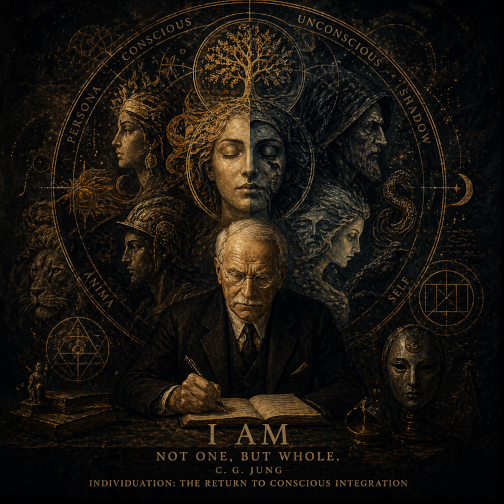
Jung describes the self that must reconcile multiplicity:
conscious / unconscious
persona / shadow
individual / archetypal
So in a strange way, the arc looks like this:
Stage | Structure | Authority |
Epic | doubled / echoed | Consensus |
“I AM” | singular / declarative | Individual |
Jung | integrated multiplicity | A Conscious Return to Consensus |
Jung’s integrated self resembles the earlier multiplicity of the ancient epics, but is now consciously held.
Instead of tracing the I AM through a progression of time, I found myself a time loop:
from multiplicity (unconscious, structural)
to singularity (asserted, authoritative)
back to multiplicity (but integrated, owned)
In early epic forms such as the Epic of Gilgamesh, meaning does not arrive fully formed in a single line. It is established through doubling a statement followed by its echo, slightly altered, reinforced through repetition.
It is as if the voice must agree with itself before it can be trusted. The statement does not stand alone. It stabilizes through internal consensus.
This creates a kind of composite speaker: anonymous, layered, not yet singular. Authority belongs to the structure of the telling, not to a person within it.
By contrast, when the “I AM” emerges as a stable form, that structure breaks.
The voice no longer repeats itself in order to hold. It does not wait for agreement. It declares.
“I AM” presents itself as fact.
What changes between the couplet and the declaration is not simply style. It is the location of authority. From an external source, to an internal source.
Only much later, in Jung, does the voice recover its multiplicity not as echo, but as integration.
This is where the psychological dimension begins to take root.
In the epic mode, the self is not yet required to be identified. The voice that speaks is supported, carried by its own repetition. It does not need to assert identity, because identity is not yet experienced as something that must be singularly owned.
With the emergence of the declarative “I AM,” that changes.
The voice collapses from a duet, into a monologue.
Authority becomes locatable, accountable. Tied to an individual. It can be claimed, attributed, believed or challenged.
The shift is a subtle but profound one.
From a voice that confirms itself, to a voice that presents itself as already confirmed
This is the beginning of what we recognize as authorship.
When Carl Jung enters the arc, he does not affirm this singular “I.”
He complicates it.
Jung’s work reveals that the unified voice is a construction, not a given. Beneath the surface of the speaking “I” lies a multiplicity of forces: archetypal patterns, unconscious material, inherited symbolic structures that shape perception long before conscious identity forms.
Individuation, in Jung’s terms, is the process by which these internal oppositions are brought into relation. The goal is not to dissolve the “I,” nor to return to anonymity, but to hold contradiction without fragmentation.
And here, the arc resolves in an unexpected way:
The early epic required two lines for truth to stand.
The declarative “I AM” required only one.
Jung asks the modern self to contain both.
Not as echo, but as integration.
“I AM.”
What began as a tool to navigate the afterlife becomes a tool to construct the interior life. What began as ritual utterance becomes psychological architecture.
Once we learned to write these forms, we learned to think inside them.
The stories we preserved did not just reflect who we were. They trained us in how to be. They taught us where to locate identity, how to experience memory, how to assemble a self out of language and time.
We became literate, and in doing so, we became legible to ourselves.
But legibility comes at a cost:
The same structures that allow us to narrate our lives also tempt us to confuse the narrative with the real. The “I” that speaks begins to feel singular, continuous, authoritative.
We forget that it is constructed. We forget that it can be revised. We forget that it was learned.
A declaration once used to pass through the gates of the dead now opens inward.
We began outside the story, telling it.
We enter it, carrying both observer and the one who acts.
And in time, we bound them and called the result:
“I AM.”
Remembering I AM
This investigation into the journey of “I AM” was sparked by my current Gorgon obsession. I wrote a poem in couplet form and set it to music, “A Voice Like Thunder” as a continuation of this lineage. It gathers what was split:
sacred/profane, creation/destruction, body/word
and speaks them in an exhortation to remember.
Through this process, The Long Memory of I AM emerged.

I began Dark Folio Press with the goal of bringing stories to light. My particular niche is Myth, Magic and Monsters. I explore symbolic literacy, forensic mythology and various forms of story-telling.
I’m a data analyst who enjoys creating queries to surface intriguing insights and pressure points for story telling. I use poetry to help me streamline my larger concepts into digestible snacks with the hopes of sparking the reader’s interest in delving deeper, at their own leisure as previous story teller’s have done for me.
This is the first of many essays I intend on publishing through Dark Folio Press and I think its an important investigation to document on this site, as an exploration into the dawn of human literature through to the present - as an example how forensic investigations into literature, folktales, myth can help us better understand ourselves, our ancestors and the world we’ve created for ourselves.
I’m currently working on another essay tracing the architectural, visual symbolism of Jeffrey Epstein’s temple on Little Saint James Island. I discovered something deeply interesting and not at all connected to the conspiracies I had encountered that shaped my initial interest. If you have read all the way through "The Long Memory of I AM", I thank you from the bottom of my heart, and I invite you to come back and read my next essay on the Temple on Little Saint James. I think it will resonate and at the very least - reveal the interesting ancient roots to the visual design Epstein chose, what it says about how he saw himself, and how he saw those he served.
Sources & Pathways
When researching, I look for: Primary texts, academic or institutional archives, consistency across multiple independent sources, clear historical context (who wrote it, when, and why)
Not all scholars agree on how to interpret Enheduanna’s work. Some view it primarily as devotional literature; others emphasize its political function. This essay leans toward the latter, but both readings are supported in scholarship.
The sources below are selected to allow readers to trace the development of the “I AM” structure across time. From ritual utterance to authored voice, theological authority, poetic revival, and psychological integration.
How to Use These Sources (A Note on Discernment)
Not all sources serve the same purpose.
When researching, consider:
Primary texts show what was said
Scholarly context explains how they are interpreted
Consistency across sources strengthens reliability
Historical context reveals why something was written
If a claim cannot be traced back to a primary text or credible scholarship, treat it as interpretation, not fact.
Ancient Egyptian Funerary Texts (Ritual “I AM”)
Pyramid Texts Earliest known religious texts (c. 2400 BCE), establishing divine identity through declarative speech. https://en.wikipedia.org/wiki/Pyramid_Texts
Egyptian Book of the Dead Later development of funerary traditions including spells, identity declarations, and navigation of the afterlife. https://en.wikipedia.org/wiki/Book_of_the_Dead
Duat Cosmological framework for the afterlife journey referenced in funerary texts. https://en.wikipedia.org/wiki/Duat
One of Dark Folio’s most popular books is our edition of the Egyptian Book of the Dead, cover illustration by SR Laing. Available in paperback and eBook.
Enheduanna & the Emergence of Authorship
The Exaltation of Inanna Primary text demonstrating early first-person authorship and political-religious rhetoric. Yale Babylonian Collection: https://babylonian-collection.yale.edu
University of Washington – Historical context on Enheduanna https://www.washington.edu/news/2015/05/05/documents-that-changed-the-world-the-exaltation-of-inanna-2300-bce/
Electronic Text Corpus of Sumerian Literature (ETCSL) Scholarly translations of Sumerian texts, including Enheduanna’s hymns https://etcsl.orinst.ox.ac.uk
Standardization of Divine Voice (Aretalogies of Isis)
Isis Aretalogies Formalized divine “I AM” declarations used across the Mediterranean world. https://rhakotis.com/2019/04/16/aretalogies/
Isis (historical overview) https://www.britannica.com/topic/Isis-Egyptian-goddess
Biblical Transformation of the Declarative Voice
Book of Exodus (Exodus 3:14) “I AM THAT I AM” as divine self-identification https://www.biblegateway.com/passage/?search=Exodus+3%3A14
Gnostic Reversal (Paradox & Instability)
Thunder, Perfect Mind A paradoxical reconfiguration of identity through contradictory declarationsThunder, Perfect Mind - Text
Romantic & Political Reawakening of the “I”
A Defence of Poetry Repositions the poet as a generative force shaping reality https://www.poetryfoundation.org/articles/69388/a-defence-of-poetry
The Masque of Anarchy Distributes the moral “I” across collective resistance https://www.poetryfoundation.org/poems/45118/the-masque-of-anarchy
Mahatma Gandhi – SatyagrahaSatyagraha
Psychological Integration
Carl Jung – IndividuationOn The Way Of Individuation - Carl Jung
The Archetypes and the Collective Unconscious Foundational text on symbolic structures and the psyche
Early Epic Structure (Pre-“I AM” Authority)
Epic of Gilgamesh Example of pre-authorial narrative structure built on repetition and pattern https://www.britannica.com/topic/Epic-of-Gilgamesh
#ForensicMythology #Enheduanna #Inanna #Isis #Goddesses #Authorship #AncientHistory #Sargon #PublicDomain #ProjectGutenberg #EgyptianBookOfTheDead #Gilgamesh #CarlJung #IAM

Comments