
Aqua Tofana: Murder as Resistance in the 17th -Century
- S.R. Laing
- Jun 27
- 8 min read
Updated: Jul 11
How a family of poisoners became the face of a hidden network of women in seventeenth-century Italy.
Somewhere in seventeenth-century Italy, women whispered about a colourless liquid capable of accomplishing what the law often could not. A few carefully measured drops, mixed into wine or broth, could produce an illness so gradual that physicians mistook it for nature taking its course. By the time suspicion arose, the victim was already dead.
The potion became known as Aqua Tofana.
If the stories are to be believed, hundreds of abusive husbands died after swallowing it.
More than a century later, as he lay dying in Vienna, Wolfgang Amadeus Mozart became convinced that he, too, had been poisoned. According to accounts preserved by his wife Constanze and others close to him, he feared he had been given Aqua Tofana, telling those around him that he could taste death and feared he had been poisoned by “Acqua Toffana.”
By the end of the eighteenth century, the poison had escaped the courtroom and entered European folklore. It had become shorthand for the perfect murder.
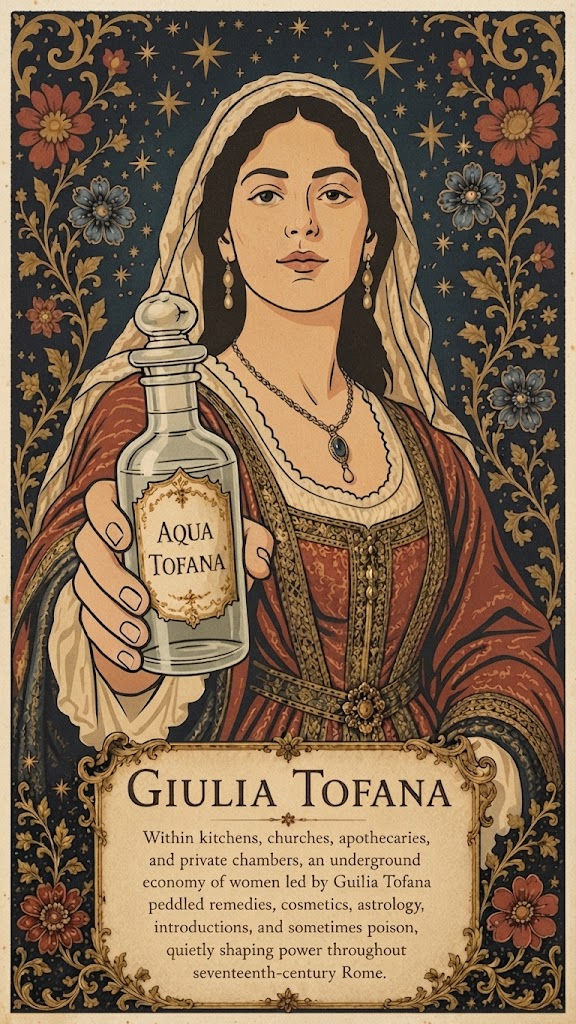
Giulia Tofana.
Guilia became the face of the legend: a brilliant poisoner who outwitted the authorities for years before her criminal empire finally collapsed in the hands of her successor.
It is an irresistible story.
The deeper I dig into the surviving records, the less convinced I am that Aqua Tofana was ever the invention of a single extraordinary woman. Every execution that should have ended the story somehow becomes the beginning of another chapter.
According to the traditional account, the toxin passed through three generations of women.
A mother.
A daughter.
A goddaughter.
Each inherited a recipe, a reputation, clients, and trust of the community.
Every time the authorities believed they had destroyed the enterprise, another woman stepped quietly into her predecessor’s place.
The earliest Sicilian records tell us remarkably little beyond the fact that the poison was associated with arsenic. Contemporary accounts are vague, offering few clues as to how it was made. The Aqua Tofana of Thofania d’Adamo’s generation appears to have been effective, but simple.
By the time the poison reached Rome under Giulia Tofana, something had changed.
Aqua Tofana is no longer described as a poison, but as a colourless, odourless liquid disguised as cosmetics or devotional oil and administered in carefully measured doses. Rather than killing immediately, it caused a progression of illness spread over several days. A first dose produced only mild discomfort. A second brought nausea and weakness. A third deepened the symptoms until, after a final administration, death appeared to arrive as the natural conclusion of disease. To physicians accustomed to epidemics of dysentery and the like, there was often little reason to suspect murder.
By the eighteenth and nineteenth centuries, the legend had grown. Writers began attributing increasingly elaborate formulas to Aqua Tofana, adding lead, antimony, belladonna, and other toxic ingredients to what had originally been described simply as an arsenic poison. Whether these later recipes preserve genuine refinements passed from one generation to the next or merely reflect centuries of embellishment is impossible to say.
What is interesting is the clear evolution of the enterprise itself.
As the story progresses, the bottles become more convincing. The dosing more deliberate. The distribution more discreet. Apothecaries, cosmeticians, astrologers, healers, midwives, widows, and trusted intermediaries each appear to occupy specialised roles within an increasingly sophisticated network built upon reputation rather than force.
It is tempting to think of Aqua Tofana as less of a fixed formula and more, as a trusted name. As any successful craft passed through generations, its methods can be refined, its ingredients altered, and its techniques improved without ever changing the reputation attached to it. The women may have changed. The cities certainly did. Yet the name endured through careful branding.
The First Execution
Palermo, 1632.
When the authorities arrested Francesca La Sarda, they believed they had uncovered a profitable trade in poison. Little survives about her beyond the charges against her. We do not know where she learned her craft. We do not know how many clients she served. We do not even know whether “La Sarda” was a family name or simply a description: the Sardinian woman.
We know only her story ended in execution. The case appeared closed.
Within a year another woman stood before the courts, Thofania d’Adamo. Unlike Francesca, Thofania would leave behind something far more durable than a criminal record.
She would leave behind her name.
Convicted of poisoning her husband and trafficking in poison throughout Palermo, Thofania was executed in 1633 under the Spanish administration governing Sicily. The authorities had every reason to believe they had dismantled the organisation responsible.
Instead, they unknowingly created its legend.
Because the poison did not disappear. The name did not disappear. If anything, both became even more famous. According to the traditional story, Thofania’s knowledge did not die with her. It passed to her daughter Giulia.
The Daughter
The woman who appears in Rome a generation later looks less like an inventor and more like an heir to Thophania D’Adamo.
She inherited a name already associated with poison. She inherited clients who already trusted it. Most importantly, she inherited a reputation.
By the middle decades of the seventeenth century, Giulia had transformed what may once have been a local criminal enterprise into something remarkably sophisticated.
Aqua Tofana was no longer simply a poison. It had become a brand.
Disguised in cosmetic bottles and devotional containers, the liquid travelled quietly through an informal marketplace almost entirely invisible to the authorities.
Every client arrived through someone she already knew. Every transaction depended upon discretion. That requirement shaped the enterprise itself.
An apothecary could prepare medicines by day and poisons by night.
A cosmetician sold powders, perfumes, and perhaps something more.
An astrologer listened to private fears, unhappy marriages, and impossible situations before quietly introducing the right person.
A midwife understood bodies.
A healer understood herbs.
A beggar could carry messages unnoticed.
Each occupation appeared perfectly ordinary.
Together they formed something extraordinary, infrastructure. One capable of surviving the death of any single participant. When Giulia died around 1651, she had already chosen a successor, Girolama Spana.
An astrologer. A fortune teller. And, according to traditional accounts, her goddaughter.
The Family Business
The more names that emerge from the Roman prosecutions, the less Aqua Tofana resembles the work of a solitary criminal genius.
Maria Spinola recruited clients.
Giovanna De Grandis prepared and distributed poison.
Laura Crispoldi connected buyers with suppliers.
Graziosa Farina moved comfortably through churches and charitable institutions where introductions could be made without attracting attention.
Even a priest, Don Girolamo, appears in the investigation, accused of helping obtain arsenic.
Every participant occupied a different corner of Roman society.
Every participant possessed different skills.
Yet together they created something surprisingly resilient.
Executions removed individuals, but the network remained.
Throughout early modern Italy, women already maintained informal systems of knowledge that operated largely outside official institutions. Midwives taught apprentices. Healers shared remedies. Astrologers cultivated loyal circles of clients. Women referred to trusted companions as mothers, daughters, sisters, godmothers, and aunts whether or not they shared blood. Knowledge passed through friendship, marriage, apprenticeship, adoption, and fictive kinship as readily as through biological families.
The records never describe Aqua Tofana as a formal sisterhood.
Nevertheless, everything about its operation resembles one.
The same channels that transmitted cosmetics, medicines, herbal knowledge, childbirth practices, and astrology could just as easily transmit something more dangerous.
Aqua Tofana did not appear out of nowhere.
It travelled along roads women had already built.
By the time Girolama Spana inherited the enterprise, those roads stretched from Palermo to Rome.
And the authorities had no idea how extensive they had become.
The Scandal They Couldn’t Ignore
The more I consider this remarkable story, the less convinced I am that murder alone explains the extraordinary response of the Roman authorities.
By 1659 they were no longer investigating suspicious deaths.
They were dismantling relationships.
Every confession produced another introduction.
Every interrogation revealed another intermediary.
Every arrest exposed another household connected to the network.
Noblewomen appeared. Merchants appeared. Servants appeared. Professional women appeared. Members of the clergy all appeared in the network.
The investigation spread through Roman society. Every husband who died represented more than a private tragedy.
A widow inherited property. A dowry changed hands. A family alliance shifted. An unwanted marriage quietly ended.
Decisions made in kitchens and bedchambers began to influence fortunes that noble families believed were secured by law.
Rome imagined itself governed by magistrates, bishops, noble houses, and papal authority.
The Spana investigation revealed another system operating quietly alongside them:
It possessed no charter.
No guildhall.
No official offices.
Only relationships.
Modern historians continue to debate the precise relationships between Thofania d’Adamo, Giulia Tofana, and Girolama Spana. Some elements of the traditional genealogy remain uncertain, and the surviving records are often fragmentary, contradictory, or filtered through hostile witnesses.
Yet one fact remains. The name endured.
Whether it passed from mother to daughter, from teacher to apprentice, or from one trusted woman to another, Aqua Tofana survived repeated arrests, executions, betrayals, and the passing of decades.
Perhaps the most remarkable thing about Aqua Tofana was never the poison itself.
It was the network of women who manufactured and distributed it.
Curious Readers
If Aqua Tofana has drawn you into the hidden world of seventeenth-century Italy, these works offer excellent places to continue exploring. Some examine the surviving court records, others investigate poison, women’s informal networks, or the legal and social world that allowed stories like Aqua Tofana to flourish.
On Aqua Tofana and Giulia Tofana
Mike Dash A Dose of Murder (Smithsonian Magazine, 2013)
A concise and accessible overview of the Aqua Tofana legend, separating documented history from centuries of embellishment.
Mike Dash The First Family of Poisoners (Smithsonian Magazine)
Explores the traditional genealogy linking Thofania d’Adamo, Giulia Tofana, and Girolama Spana while discussing the uncertainty surrounding many of the surviving accounts.
Women, Medicine, and Informal Knowledge
Monica H. Green (ed.) Women’s Healthcare in the Medieval West
An excellent introduction to women’s medical practice, healing traditions, and the transmission of practical knowledge outside universities.
David Gentilcore Healers and Healing in Early Modern Italy
A detailed study of physicians, apothecaries, midwives, folk healers, and the blurred boundaries between official and unofficial medicine.
Sandra Cavallo Artisans of the Body in Early Modern Italy
Explores barber-surgeons, apothecaries, cosmeticians, and other practitioners who occupied the everyday world where beauty, medicine, and chemistry frequently overlapped.
Poison in History
Adrienne Mayor Greek Fire, Poison Arrows & Scorpion Bombs
A fascinating survey of poisons, toxic substances, and chemical warfare from antiquity, illustrating humanity’s long fascination with invisible weapons.
Deborah Blum The Poisoner’s Handbook
Not about Aqua Tofana directly, but an engaging account of how forensic science eventually learned to detect the very kinds of poisons that once escaped suspicion.
Hidden Networks of Women
Readers interested in the broader idea of informal female networks may also enjoy:
Laurel Thatcher Ulrich Good Wives: Image and Reality in the Lives of Women in Northern New England, 1650–1750
A classic study showing how women built resilient communities through kinship, neighbourly exchange, and shared practical knowledge.
Natalie Zemon Davis Women on the Margins
Examines women who navigated the intellectual, commercial, and religious worlds of early modern Europe beyond the limits imposed by official institutions.
Silvia Federici Caliban and the Witch
A provocative and influential interpretation of gender, power, witchcraft, and social control during Europe’s transition to the modern world. While many of Federici’s arguments remain debated among historians, her work has profoundly shaped discussions about women’s labour and informal networks.
A Note on the Sources
The history of Aqua Tofana is notoriously difficult to reconstruct. Many surviving accounts were written decades after the events they describe, and others passed through hostile witnesses, inquisitorial records, or later retellings that blurred fact with folklore.
Historians continue to debate the precise relationships between Thofania d’Adamo, Giulia Tofana, and Girolama Spana. Like the legend itself, the evidence survives only in fragments.


Comments