
Worth Celebrating
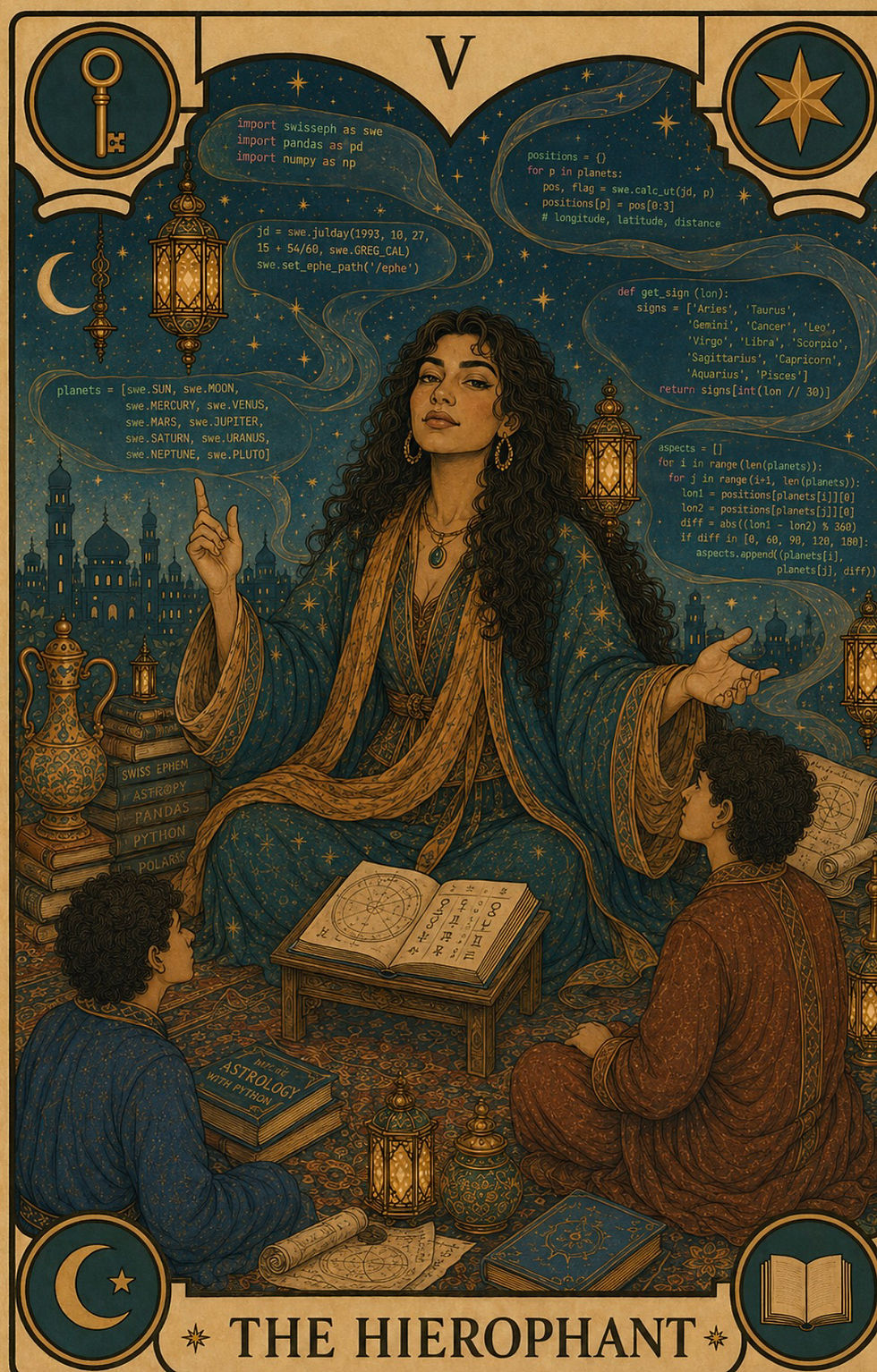
This week marked a significant milestone for Dark Folio.
What began as an experiment has matured into something much larger than I originally imagined, an editorial platform built on deterministic astronomical calculations, symbolic interpretation, human craftsmanship, and thoughtful reflection.
Daily, Weekly, Monthly astrology features that can be delivered by pdf, html, widgets, or API.
The philosophy behind the project hasn’t changed since day one.
Calculate with precision.
Interpret symbolically.
Write evocatively.
Edit intentionally.
Encourage reflection.
Never claim certainty where mystery remains.
Deliver Digitally
These principles have quietly guided every line of code I’ve written and every horoscope I’ve edited.
A New Chapter: Personal Birth Charts
This week I also began building the Personal Birth Chart section of the platform.
To test the system properly, I didn’t just generate a handful of charts, I pushed it!
The first beta phase concluded with 27 completed natal chart analyses (well… technically a few more if we count the ones I regenerated after discovering edge cases 😉).
Those charts represented clients across seven nations and six decades of birth dates, giving the software opportunities to encounter an enormous variety of planetary configurations, locations, historical time zones, and life stories.
The diversity of those charts proved invaluable.
Debugging the Sky
The beta process wasn’t simply about reading astrology.
It became an exercise in software engineering.
Historical daylight saving rules.
Time zone changes.
Small communities with unreliable geocoding.
Latitude and longitude verification.
Pre-1950 edge cases.
Every discrepancy became an opportunity to improve the engine rather than work around it.
The Twin Edge Case
One of the most fascinating investigations during beta testing involved a pair of identical twins born just one minute apart.
At first glance, their charts appeared nearly identical.
Yet the generated narratives were noticeably different.
My initial hypothesis was that the language model had become inconsistent.
It hadn’t.
After tracing the calculations step by step, the findings were elegant: after the calculations are completed & verified the aspects are weighted before passing data to the LLM assistant ensuring the planets themselves remained effectively identical as did the houses.
What changed were the parts of the chart anchored to the observer’s horizon:
Ascendant
Midheaven
House cusps
Angular relationships
Planetary weighting within the interpretive engine
The heavens had not moved.
The horizon had! By exactly 19 arcminutes, just enough to tilt the Earth's axis & offer a unique celestial configuration for the younger twin’s entry.
That realization became one of my favorite discoveries of the beta.
It reinforced an important distinction between astronomical calculation and symbolic interpretation. Even when the planets occupy nearly the same positions, a subtle shift in the local horizon can meaningfully alter how those same planetary energies are expressed within a chart.
Rather than revealing a flaw in the software, the twins demonstrated that the engine was sensitive to exactly the kinds of changes it was designed to detect.
For me, it was one of those rare moments where debugging became a lesson in astrology itself.
Somewhere Along the Way…
In the beginning, my questions were almost entirely technical.
Are the planetary positions correct?
Does this agree with established astrological sources?
Did historical daylight saving rules change the Ascendant?
Is the latitude precise enough?
As confidence in the calculations grew, the questions changed.
Instead of asking whether a chart was mathematically correct, I began asking:
What story does this chart tell?
What themes keep repeating?
What strengths deserve more attention than the challenges?
What would I actually say if this person were sitting across from me?
The exercise slowly transformed from debugging an astrology engine into developing a heart felt editorial voice.
Every Chart Is Different
Some charts are straightforward.
Others ask you to slow down.
One early beta reader (who I privately nicknamed Tender Heart) reminded me that astrology isn’t just a collection of planetary placements. It can become a language for understanding compassion, boundaries, resilience, and growth.
Another beta participant reached out during an incredibly difficult period of life. Rather than rushing the report, I deliberately slowed the process down.
I expanded the research to include additional symbolic indicators related to healing, opportunity, and renewal not to manufacture certainty, but to provide thoughtful context and leave space for hope where appropriate.
Those reports reinforced something I’ve come to believe about responsible astrology:
The goal isn’t to predict a person’s future.
The goal is to help them reflect on their innate skills & talents that if leaned into can help them generate solutions for the moment they are preparing to meet.
Human Editorial Work Matters
Every report crafted by Dark Folio Press follows the same philosophy:
The astronomical calculations are deterministic.
The symbolism is drawn from established astrological tradition.
The interpretation is drafted with assistance.
The editorial judgment remains human.
Each report is reviewed, refined, questioned, and rewritten where necessary.
I don’t want readers to receive generic descriptions that could apply to anyone.
I want each report to feel like someone genuinely spent time understanding the symbolic language of their chart.
That human step is, and will continue to be, the heart of this project.
Looking Ahead
Twenty-seven charts is a tiny sample compared to where I hope this project will eventually go.
But they’re enough to demonstrate that the foundation is becoming solid.
The software is becoming more reliable.
The editorial process is intentional.
And perhaps most importantly…
I’m no longer just building astrology software.
I’m building an editorial process that treats astrology as a language for reflection rather than certainty.
That has always been the destination.
This week simply made it feel real.
Comments